
Egg Vending Machine Buying Guide for Farms and Retailers
WEIMI Farm Retail Guide
Egg Vending Machine Buying Guide for Farms and Retailers
A practical guide for farms and retailers comparing locker design, refrigeration, capacity, payments, installation, costs and daily operation.
An egg vending machine allows farms and retailers to sell packaged eggs beyond staffed opening hours. Customers select a product, complete payment and collect the carton from a secure compartment, while the operator manages prices, stock and machine status remotely.
The concept is simple. Choosing the right machine is not. Eggs are fragile, carton sizes vary, storage rules differ between markets, and a poor location can undermine capable equipment. Buyers need to evaluate the complete retail system rather than choosing by appearance or locker count alone.
What Is an Egg Vending Machine
An egg vending machine is an automated retail cabinet that stores packaged eggs in individual lockers or controlled compartments and releases the selected order after payment or pickup code verification.
A complete system normally combines secure product storage, touchscreen selection, payment processing, inventory software and remote machine monitoring. Refrigerated models add active cooling, temperature sensors and operational alerts.
How a Typical Purchase Works
- Product selection: The customer chooses an egg size, carton quantity or product grade.
- Payment: The system requests payment through the configured card reader, QR payment or another supported method.
- Locker release: The assigned compartment unlocks after payment approval.
- Collection: The customer removes the carton without a mechanical drop.
- Inventory update: The system records the transaction and marks the locker as empty.
Who Should Consider an Egg Vending Machine
Poultry Farms and Egg Producers
A farm can place the machine near its entrance and sell directly to residents, commuters and passing drivers. This extends access beyond farm shop hours without requiring continuous counter staffing.
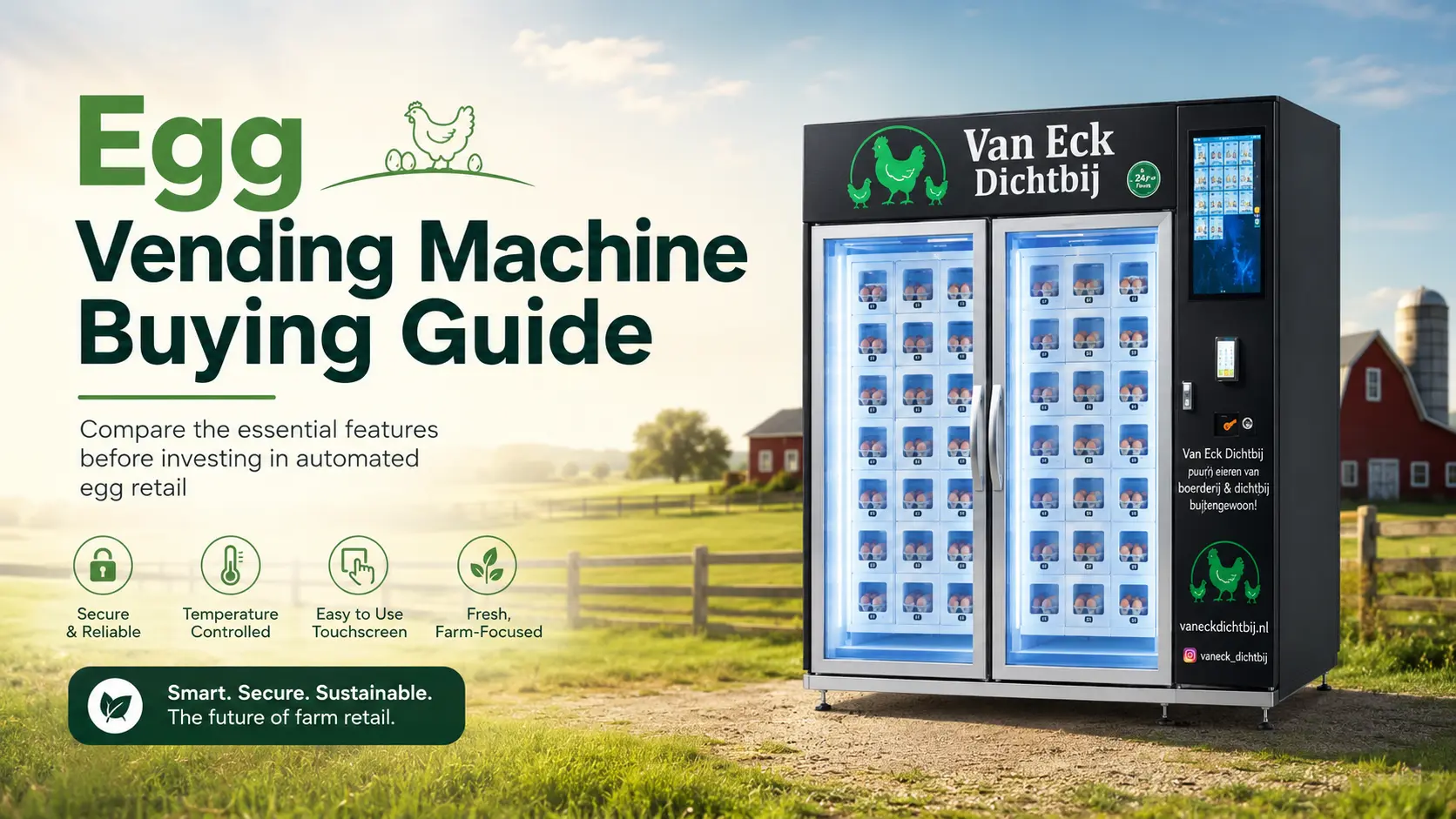
The Dutch farm egg vending case illustrates how a farm entrance can become an automated retail point serving customers during mornings, evenings and weekends.
Farm Shops and Agricultural Cooperatives
A farm shop can use the machine after closing or as an overflow channel during busy periods. Cooperatives may offer eggs alongside appropriately stored milk, cheese, potatoes, honey and other packaged farm products.
Supermarkets and Community Retailers
Retailers can install a cabinet outside a store, inside a lobby or beside a pickup area. A visible community location may also serve customers who want convenient access to locally produced food.
Why Locker Design Matters for Egg Sales
Egg cartons should remain stable from loading to collection. Individual lockers store each customer order in a separate compartment and open only the assigned door after payment. They reduce product movement, support several carton sizes and work well with pickup codes.
Elevator machines can offer greater capacity, but they must be tested with fully loaded production cartons. Conventional spiral channels are generally a weak choice because a carton may shift, tilt or fall during delivery.
Professional Comparison of Egg Retail Systems
| Evaluation Factor | Refrigerated Locker | Ambient Locker | Elevator Machine | Staffed Farm Shop |
|---|---|---|---|---|
| Carton protection | Excellent | Excellent | Good if tested | Excellent |
| Temperature control | Integrated | Not available | Optional | Separate equipment |
| Pack size flexibility | High | High | Moderate | Very high |
| Unattended access | Yes | Yes | Yes | No |
| Main purchasing risk | Incorrect cooling or locker size | Unsuitable storage conditions | Delivery failure or damage | Recurring labor cost |
| Best application | Controlled storage and fragile products | Permitted ambient storage | Standard high volume packs | Broad assortment and personal service |
Refrigeration and Egg Freshness
Egg storage rules are not identical worldwide. Some markets maintain eggs under refrigeration throughout retail distribution, while others permit or require different handling. A machine temperature range is an equipment capability, not a universal storage recommendation.
Before selecting a refrigerated or ambient system, confirm local food rules, the existing production and transport process, required temperature records, labeling obligations and withdrawal procedures.
What to Verify in a Cooling System
- Temperature stability across the occupied lockers
- Sensor position and calibration procedure
- High temperature alarms and remote records
- Recovery time after repeated door openings
- Condensation and drainage management
- Compressor ventilation clearance
- Performance under expected outdoor conditions
- Behavior during network or power interruptions
One WEIMI refrigerated egg vending machine lists a configurable 3 to 20°C operating range. The buyer must still establish a compliant setpoint for the destination market and supply chain.
Capacity and Locker Size Planning
Published locker count can be misleading. A cabinet with many small compartments may hold fewer usable egg cartons than one with fewer correctly sized lockers.
Measure Every Sales Pack
Record carton width, depth, height and loaded weight. Allow enough clearance for customers to grip and remove the carton without tilting or squeezing it. Packaging variation and winter gloves should be considered during testing.
Plan Capacity by Product Type
If a machine has 38 lockers and each holds one order, 20 daily transactions represent less than two average days of theoretical capacity. The real constraint appears when the best selling carton runs out while slower products still occupy other lockers.
A starting allocation might reserve 50 percent of positions for the highest volume carton, 25 percent for the second most popular pack, 15 percent for premium eggs and 10 percent for product tests. Real sales data should replace these assumptions after launch.
Payments Customer Experience and Software
Payment requirements differ by market. Contactless cards may dominate one location, while QR payments, mobile wallets, cash or coins remain important elsewhere.
Confirm Local Payment Compatibility
- Payment terminal model and local acquiring support
- Accepted cards, wallets and QR platforms
- Currency, tax and receipt settings
- Transaction fees and settlement terms
- Refund and failed payment procedures
- Offline behavior and network requirements
- Warranty and technical support responsibility
A cabinet may physically accept a card reader without being integrated with an acquiring provider in the destination country. Obtain written confirmation before production.
Request a Live Software Demonstration
- Create a product and add its price.
- Assign the product to selected lockers.
- Complete a test purchase.
- Verify the inventory change.
- Change the price remotely.
- Trigger a low stock or temperature alert.
- Demonstrate a refund.
- Export a sales report.
Also clarify data ownership, export access, record retention and what happens if the software subscription ends.
Location Selection and Installation
A capable machine can fail in a poor location. The best site combines proven demand, safe access, clear visibility and manageable service costs.
Score the Proposed Location
Give each factor a score from one to five:
High passing traffic does not compensate for unsafe stopping or poor visibility. A customer who cannot enter the site easily is not useful traffic.
Installation Checks
- Machine footprint and door opening clearance
- Rear and side ventilation space
- Level load bearing surface
- Delivery route and unloading equipment
- Correct voltage frequency and circuit protection
- Primary network and fallback connection
- Canopy drainage lighting and surveillance
- Technician and replenishment access
Egg Vending Machine Costs and Profitability
There is no responsible universal machine price. The total depends on locker design, refrigeration, payment integration, software, branding, freight and destination requirements.
Calculate Total Installed Cost
- Machine and selected options
- Payment hardware and integration
- Locker customization and branding
- Software and connectivity setup
- Freight customs and local delivery
- Electrical and site preparation
- Weather protection and security
- Initial spare parts and training
Estimate Operating Contribution
Contribution per Carton
Selling price minus product cost minus packaging minus payment fee minus estimated product loss
Monthly Operating Contribution
Contribution per carton multiplied by monthly cartons sold minus monthly operating expenses
Model weak, base and strong sales scenarios. Do not use maximum locker capacity as expected sales because storage capacity does not prove customer demand.
Daily Restocking Cleaning and Maintenance
An unattended machine still requires disciplined human operation. During each service visit, staff should inspect cartons, apply the approved stock rotation procedure, refill lockers according to demand, reconcile physical and digital inventory and review alarms.
Service Visit Checklist
- Inspect packaging and remove unsuitable products.
- Load stock according to the approved rotation process.
- Check locker doors seals and locks.
- Clean handles touchscreen and payment areas.
- Verify the temperature display and records.
- Review failed transactions and customer cases.
- Confirm network and payment terminal status.
- Record the completed service visit.
Preventive maintenance should cover locks, hinges, seals, refrigeration components, sensors, payment hardware, network equipment and exterior damage. The agreement should identify who handles each system.
How to Compare Suppliers and Configurations
The strongest supplier is not necessarily the company with the longest feature list. Evaluate evidence, configuration discipline and support capability.
Information to Provide Before Quotation
- Carton dimensions and weights
- Product photographs
- Expected sales by pack size
- Required storage conditions
- Indoor or outdoor placement
- Destination country
- Preferred payment methods
- Power and connectivity
- Branding and language
- Service expectations
WEIMI Egg Vending Options
WEIMI provides an egg vending machine range for farm, supermarket and community applications.
One published refrigerated configuration combines 38 customizable lockers with a 21.5 inch touchscreen and remote inventory functions. These details describe one configuration rather than every machine.
Buyers planning a broader assortment can also evaluate a farm products vending machine with cooling lockers. The final specification should be based on verified cartons, site conditions and local payment requirements.
Final Buyer Checklist
How Much Does an AI Powered Visual Recognition Cabinet Cost A Complete Price Guide
Trading Card Vending Machine Store Buyer Guide
Related Article
