Baked Goods Vending Machine: How Do You Prevent Damage?
Prevent avoidable damage in a baked goods vending machine by testing the actual product and final package through loading and customer collection. Assess direct locker collection first where the pack fits; for a dispensing cabinet, also observe release and every transfer. Use the evidence to approve or revise the configuration. An elevator alone does not prove that a decorated cake or brittle cookie will arrive intact.
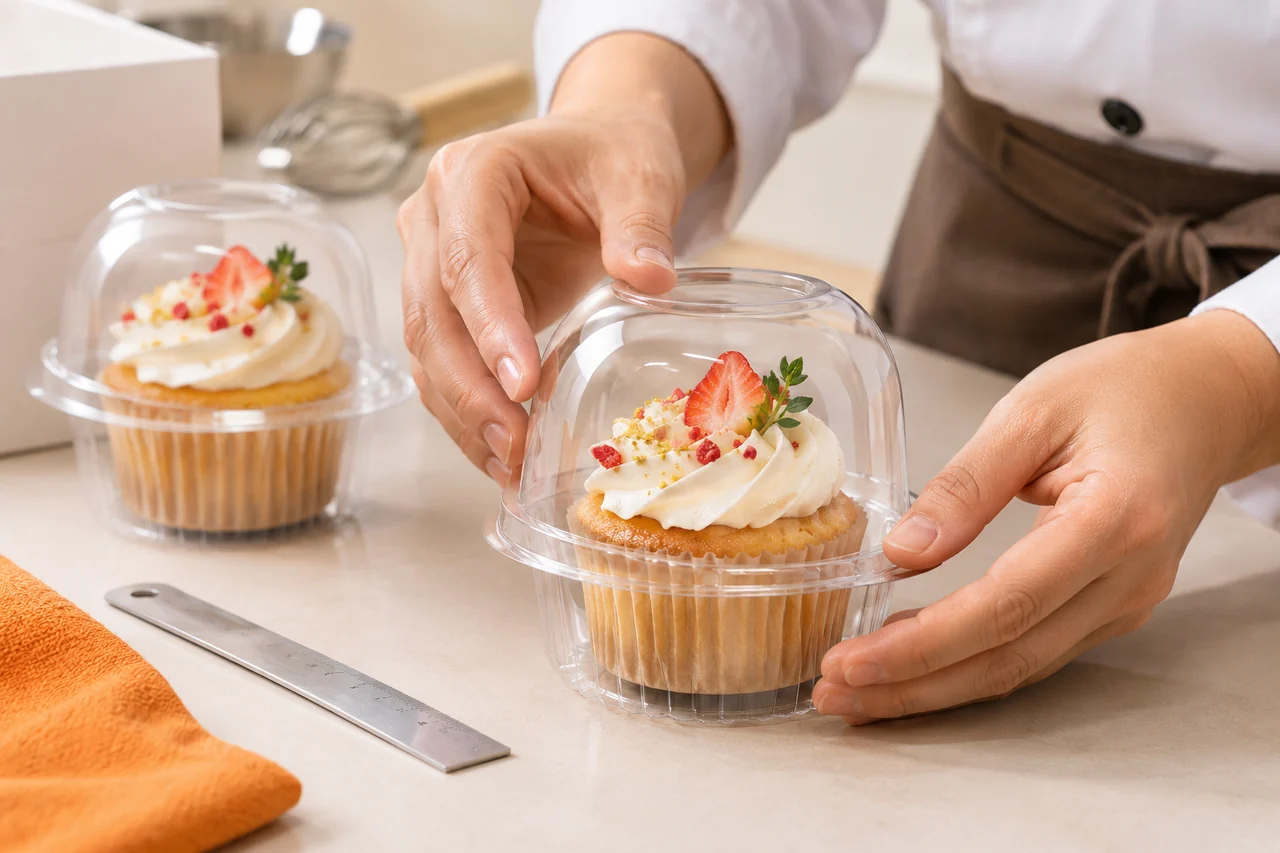
Define damage before judging a demonstration
Vending damage is any change during storage, handling or collection that makes the item fail the bakery's agreed saleable condition. It can include broken food, displaced decoration, a crushed carton, an opened seal or a pack the customer cannot remove normally.
Agree the acceptance criteria before testing. A sealed cookie pouch may look perfect while containing crumbs. A cupcake dome may remain closed while frosting has touched its lid. The supplier and bakery need the same definition of a saleable result, including an inspection of the food inside the pack.
Separate appearance, containment and handling
For appearance, record acceptable product position and decoration clearance. For containment, examine the seal, lid and base. For handling, confirm that one selected pack reaches pickup and can be collected without squeezing or tilting it excessively. These checks make a bakery vending machine test useful to production and retail teams, rather than merely proving that a motor moved.
Map each point where the package can fail
| Stage | Potential failure | What to observe | Possible change to assess |
|---|---|---|---|
| Loading | Pack crushed, misoriented or held by a loose closure | Clearance, operator handling and repeatable position | Tray spacing, loading method or package dimensions |
| Release | Two packs move together, bag catches or box rotates | Separation and contact with the tray mechanism | Channel arrangement, pack stiffness or tray option |
| Transfer | Pack tips, slides or meets an unsupported gap | Platform alignment and each handoff | Approved transfer arrangement or supported base |
| Pickup presentation | Door contacts the pack or product arrives in an awkward orientation | Final position and clear opening | Package orientation or compatible pickup configuration |
| Customer removal | Box must be squeezed, tilted or dragged across an edge | Hand access and level removal | Pack size, pickup clearance or a different delivery format |
Change one relevant variable at a time and repeat the affected route. If the tray and pack are changed together, it becomes difficult to identify what solved the problem or reproduce the result later.
Compare direct locker collection with mechanical transfer
Test the locker opening and the customer's removal action
The WM22-CL locker reference uses electric locks and a 36 + 4 compartment arrangement. Direct collection avoids a shared dispensing route, but the box still needs space for loading and removal. The smaller W16 × H15 × D46 cm and larger W24 × H20 × D46 cm reference compartments will not fit every cake box.
Test the clear door opening with the actual pack and demonstrate collection without crushing or excessive tilting. Different 6, 20, 32 or 40 compartment structures can be assessed for the assortment. Choose by package clearance, not by the highest compartment count.
Check every handoff rather than only the final door
An elevator vending machine transports a receiving platform to collect or move the product. The pack still leaves a tray, meets a platform and arrives at pickup. Ask for a continuous view of the entire route where practicable, supported by close views of concealed transfer points.
The WEIMI WM600-W cookie vending machine reference uses elevator and conveyor transfer to middle pickup. For a rigid brownie carton, observe its base support and orientation at each transition. For cookies, open the delivered pack and compare the contents with an unvended sample from the same batch.
Assess decorated cakes with their final lids and inserts
The WM22-XY cupcake vending machine reference uses an X-Y elevator and middle automatic pickup. Its first-image specification lists direct push as the default and conveyor as an option. The correct arrangement depends on the package; infrared detection does not measure whether frosting has remained untouched.
A cupcake packaging test must include the actual base insert, dome, label and decoration. An empty rigid box can establish basic clearance, but cannot reproduce the loaded weight, moving contents or internal contact risk. A taller dome can also create a new clearance problem elsewhere in the route.
Prepare samples that represent everyday production
Send examples from the normal production process, including the largest normal pack and the most delicate presentation. Identify normal variation in weight and dimensions. A specially selected compact sample can pass while ordinary shop stock catches a shelf edge.
WEIMI accepts actual samples and takes pre-shipment video for customer confirmation. Agree the scope beforehand: which SKUs, which packaging revision, what the video must show and how results will be recorded. There is no confirmed universal test-cycle count, zero-damage promise or fixed acceptance standard to assume.
Keep a simple sample-test record
Use one row per SKU and pack revision. Record maximum external dimensions, loaded weight range, orientation, product condition, tray position, test date and the observed outcome. Attach photographs before and after delivery, including an opened pack where needed.
Add a decision field: approved, revise and retest, or unsuitable for the proposed route. Give each failed result a visible description, such as “front corner catches during transfer,” instead of the vague note “does not work.” This gives the next test a clear purpose.
Run a practical sample-test procedure
- Agree saleable-condition criteria and photograph the untouched product inside its final closed pack.
- Measure and weigh the sample, then record the tray, orientation and packaging revision.
- Observe loading and the full selected-item route, including each transfer and pickup.
- Collect the pack normally, inspect the exterior and contents, and record any damage.
- Revise one cause at a time, repeat the affected checks and document the approved arrangement.
This procedure is a recommended buyer acceptance method, not a report of factory results. Agree the number and variety of demonstrations with the supplier according to your product risks. Include conditions such as different approved shelf positions or stocking levels where they could affect handling.
Key takeaway: a recorded pass applies to the tested package and configuration; it should not silently approve a different box, recipe or tray.
Protect the result after installation
Control package changes and loading habits
Keep a photograph of the approved orientation with the refill instructions. Do not exceed the agreed loading arrangement or force a pack into a tight position. If an operator reports damage, compare the current stock and packaging revision with the original bakery vending machine test record before changing machine settings.
A bakery chain should ask its packaging supplier to flag changes in dimensions, material or closure. Even a lower-cost carton that looks similar can flex differently. Repeat the relevant handling checks after a material change.
Separate machine handling from upstream damage
Inspect a sample before loading as well as after vending. Damage from delivery to the site, stacking or rough loading can otherwise be blamed on the cabinet. Cooling and food-condition questions also need separate verification: a clean mechanical pass does not establish safe storage or shelf life.
Frequently asked questions
1. Does an elevator guarantee damage-free delivery?
No. An elevator vending machine still requires a compatible package, supported transfers and practical pickup clearance. Approve evidence from actual samples.
2. Can I test using an empty box?
Use it for preliminary clearance only. Final assessment needs a sale-ready product to reproduce weight, stability and internal movement.
3. What should a cookie vending machine test include?
Inspect the cookie contents after delivery, as well as the wrapper and seal. Compare with an unvended sample to distinguish pre-existing breakage.
4. What is important for a cupcake vending machine?
Observe decoration clearance, base retention, platform support and collection. A closed lid alone does not prove that the cupcake stayed presentable.
5. How many cycles should we request?
Agree a risk-based demonstration plan with the supplier. No universal count has been established for every product and configuration.
6. Can WEIMI test our actual products?
Yes. Customers can send actual samples, and pre-shipment video is provided for customer confirmation. Agree the scope and approval criteria in advance.
7. What if the package catches during release?
Record the exact contact point. Assess tray arrangement, orientation or packaging changes with the supplier, then retest rather than forcing the pack through.
8. Can I use stronger cupcake packaging instead of changing the route?
Possibly, but retest the revised dimensions, support and removal. A stronger pack can still be too large or unstable for the proposed route.
9. Does a delivery sensor verify food appearance?
Do not assume that. A sensor's detection function does not establish the condition of decorations or contents inside a closed package.
10. When should we repeat the test?
Repeat relevant checks after material changes to packaging, product geometry, weight, tray or delivery configuration, and after unexplained damage reports.
Request evidence for your most difficult package
Send WEIMI the most fragile pack in your planned range, with an ordinary production sample for comparison. Assess the WM22-CL refrigerated locker configuration where direct collection is appropriate. Include acceptance criteria and request the full handling and collection demonstration. Choose a baked goods vending machine after the product, pack and approved arrangement have demonstrated a saleable result together.
Baked Goods Vending Machine Cost: What Does a Quote Include?
Baked Goods Vending Machine: Do Your Products Need Cooling?
Related Article